> For the complete documentation index, see [llms.txt](https://docs.influxtechnology.com/support_guides/llms.txt). Markdown versions of documentation pages are available by appending `.md` to page URLs; this page is available as [Markdown](https://docs.influxtechnology.com/support_guides/rexgen-series-product-manuals/rexgen-1/rexgen-1-product-manual/hardware-functions-and-accessories/hardware.md).
# Hardware
### Installation
The contents below specify the conditions required for the operation of ReXgen1.
**GROUNDING**
Since providing a common ground between nodes is not required, it is possible to have ground offsets between nodes. Each node may observe different single-ended bus voltages (common mode bus voltages) while maintaining the same differential voltage. Operating a CAN system with large ground offsets can increase electromagnetic emissions. If the system is sensitive to emissions, steps must be taken to eliminate ground offsets.
**TERMINATION**
ISO-11898 requires that the CAN bus have a nominal characteristic line impedance of 120Ω. Therefore, the typical terminating resistor value for each bus end is 120Ω. Bus termination is used to minimise signal reflection on the bus.
**SUPPLY VOLTAGE**
It is always recommended to keep the nominal voltage within the specified range. The device also has internal protection against low-energy voltage events due to supply wire noise.
**ISOLATION**
CAN Bus and USB are not isolated; care must be taken when plugging the USB into the device. Removing the power supply when the device is interfaced with a PC via a Micro USB cable is advised.
{% hint style="warning" %}
**Notes:**
* The CAN Bus Isolator and USB Isolators can be purchased separately.
* Please do not use the logger's USB port for data logging, as it may damage the port and will not be covered under warranty.
{% endhint %}
**MOUNTING**
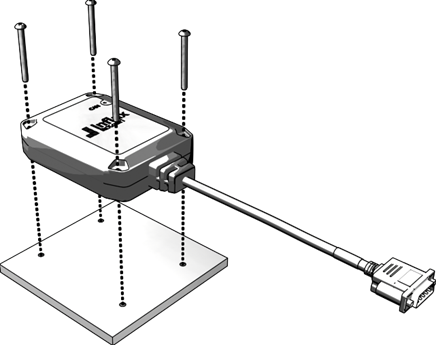
Always mount the device in a way that minimises vibration exposure and accounts for its IP rating. ReXgen1 includes four screws to assist with mounting.
---
# Agent Instructions
This documentation is published with GitBook. GitBook is the documentation platform designed so that both humans and AI agents can read, navigate, and reason over technical content effectively. Learn more at gitbook.com.
## Querying This Documentation
If you need additional information that is not directly available in this page, you can query the documentation by asking a question.
Perform an HTTP GET request on the following URL with the `ask` and `goal` query parameters:
```
GET https://docs.influxtechnology.com/support_guides/rexgen-series-product-manuals/rexgen-1/rexgen-1-product-manual/hardware-functions-and-accessories/hardware.md?ask=&goal=
```
`ask` is the immediate question: it should be specific, self-contained, and written in natural language.
`goal` is what the user is ultimately trying to achieve, the reason they need the answer. Sharing it helps GitBook give you a better, more relevant answer. A goal is most helpful when it describes the outcome the user wants rather than restating the question. For example, with `ask=how do I create an API token`, a goal like `automate deployments from our CI pipeline` lets GitBook tailor the answer to that use case.
The response will contain a direct answer to the question and relevant excerpts and sources from the documentation.
Use this mechanism when the answer is not explicitly present in the current page, you need clarification or additional context, or you want to retrieve related documentation sections.